Home
/
Blog
/
Preparing for tech shifts
Eugene Fine
CEO at CIDT
All
Thought Leadership
February 27, 2026
3 min
Article covers
Ready for your next project?
Let's talk

Preparing for tech shifts

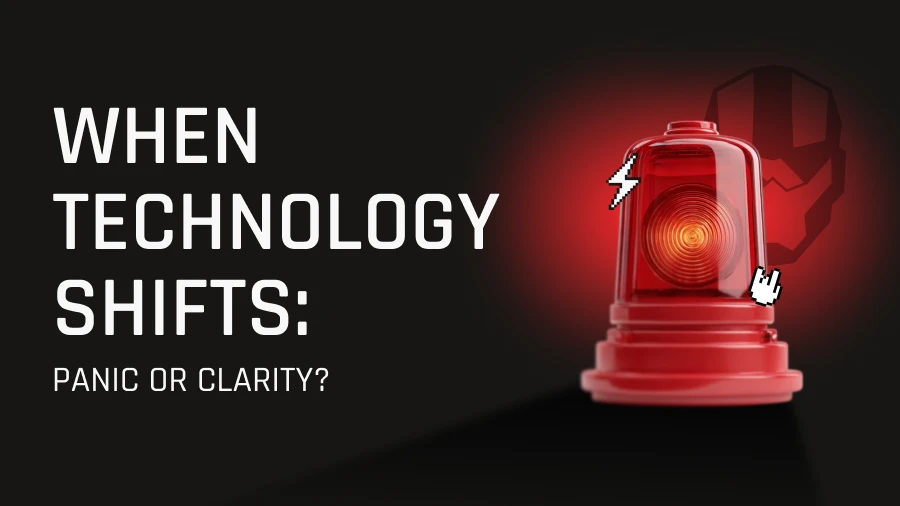
Technology shifts don’t usually fail because teams move too slowly. They fail because teams move without clarity.

I’ve been building software long enough to recognize a familiar pattern.

Every time technology shifts in a meaningful way, the reaction looks the same. Uncertainty rises. Noise gets louder. Teams feel pressure to act fast - often before they fully understand what’s changing.

That reaction is human. What matters is what happens next.

The current shift is real - and it’s different

Right now, the conversation everywhere is about AI and LLMs. And at CIDT, we're not watching from the sidelines. We're already building agentic AI pipelines, integrating AI into client development workflows, and using it to improve how we write, test, and ship software.

So I say this from the inside: the shift is real. It's already affecting how teams think about their roles, their tools, and their delivery cycles. This isn't a hypothetical future. It's happening in real projects, with real constraints, right now.

And that's exactly why the emotional response matters so much.

Panic looks a lot like reasonable decisions

I've seen it show up as pressure to "add AI" without a clear problem it solves. Replacing stable systems too early because they suddenly feel outdated. Chasing tools because competitors are talking about them. Confusing experimentation with immediate adoption.

None of this is irrational. But none of it helps teams adapt well. Panic compresses thinking. It pushes decisions earlier than they need to be made. And in a client-facing environment, that has real consequences.

Multiple technology cycles teach you what actually matters

Over the years, I’ve watched the industry move through more than one major shift. Architectures changed. Assumptions changed. Best practices were rewritten.

Each cycle came with the same promise: this will change everything. Sometimes it did. Sometimes it didn’t - at least not in the way people expected.

What experience gives you isn't immunity to change. It gives you pattern recognition. You start to see that the real question is never "Should we adopt this?" It's "What problem are we actually solving?" Right?

Fear and excitement are both part of it

Every meaningful shift brings both. It's exciting because it opens new capabilities — and I genuinely am excited about what we're building at CIDT with AI. It's also unsettling because it challenges what already works.

The goal isn't to eliminate fear — that's unrealistic. And ignoring the excitement would be a mistake too. The goal is to keep decision-making grounded while both are present. That's what allows teams to explore without destabilizing themselves or their clients.

What actually keeps teams stable during a shift like this

Teams that don't panic tend to rely on the same underlying habits. Being clear about where automation helps and where it introduces risk. Protecting existing delivery pipelines while experimenting in parallel. Resisting the urge to rebuild everything at once. Keeping quality and review processes intact even when tools change.

When those habits are in place, new technology becomes something to integrate — not something that threatens everything else. We've seen this firsthand as we've rolled out AI tooling across our own development workflow at CIDT.

Calm leadership means decisions made for the right reasons

During moments like this, teams don't expect leaders to know exactly what will happen next. They look for signals. Are we panicking? Are we rushing to look modern? Are we abandoning systems that still work?

Or are we evaluating carefully, experimenting deliberately, and giving people room to learn?

Calm leadership doesn't mean slow decisions. It means decisions made for the right reasons.

The exciting part is real — if you give it the right structure

AI and LLMs will keep evolving. That's not optional. What is optional is whether fear drives the response.

At CIDT, we're choosing to focus on what these tools can genuinely improve — delivery speed, code quality, how we scale our teams' capabilities — while staying grounded in what keeps clients' systems stable and reliable.

Staying calm isn't about resisting change. It's about giving change the structure it needs to actually become useful.

Frequently asked Questions

1.
How should software development teams approach AI adoption?
Start with the problem, not the tool. AI adoption works best when teams are clear about what specific part of their workflow they're improving — whether that's code review, testing, bug fixing, or documentation. Adopting AI without that clarity usually creates more noise than value.
2.
What are the risks of moving too fast with AI in software development?
The biggest risk is destabilizing delivery pipelines that already work. Teams that rush to replace stable systems often end up slowing down while they sort out what broke. Experimenting in parallel — without disrupting live production — is a more reliable path.
3.
How is AI changing software development teams and their roles?
AI is shifting where developers spend their time — less on repetitive tasks, more on design decisions, client requirements, and edge cases that automation can't resolve. The teams adapting well are the ones treating AI as a productivity layer, not a replacement for engineering judgment.
4.
What does responsible AI integration look like for a software company?
It means keeping humans in the review loop, tracking the effectiveness of AI-generated output over time, and being transparent with clients about where and how AI is being used. It also means not cutting corners on QA just because a tool generated the code.
5.
How do you evaluate whether an AI tool is actually improving your team's output?
Track it. For every workflow you automate, measure the result — how often does the AI output require minor adjustments, significant rework, or get discarded entirely? Without that data, you're guessing. With it, you can make real decisions about where AI is earning its place.

Related Articles

Show All
CIDT superhero symbolizing client success and project results
February 27, 2026
3 min
Preparing for tech shifts

Most teams feel pressure to act the moment a new technology wave hits. The ones that adapt well don't move faster — they move with more clarity. Here's what that looks like in practice.

Eugene Fine
,
CEO at CIDT
All
Thought Leadership
February 27, 2026
Culture is tested in emergencies

Most teams look fine when things are calm. Culture only becomes visible when something breaks. This is about what actually happens under pressure — and what separates teams that recover quickly from those that don't.

Eugene Fine
,
CEO at CIDT
All
Thought Leadership
February 18, 2026
9 min
Why institutions automate trading

As trading activity scales, manual execution becomes a source of risk rather than control. This article explains why institutions turn to automation to keep execution predictable, auditable, and reliable.

CIDT Team
,
Content Writer
All
DeFi Operations
Web3/Blockchain
February 18, 2026
9 min
Open source software: legal risks & pitfalls

Open source can save time and budget, but it is rarely risk-free. This article shows what to check in open source licenses and highlights common pitfalls that can create problems at release or during scaling.

Iva Posobchuk
,
General Counsel
All
IT consulting
February 17, 2026
4 min
Ten years, built by people

This article looks back at how CIDT began with real work, grew through uncertainty, and scaled without losing its culture. Because after a decade, the most important thing we’ve built isn’t technology.

CIDT Team
,
Content Writer
All
News
January 23, 2026
2 min
What makes CIDT different after 10 years in consulting

We reflect on what it takes to last in consulting. Why long-term continuity is rare, how trust is built through everyday decisions, and why systems ~ not personalities ~ are what sustain teams, clients, and growth over time.

Eugene Fine
,
CEO at CIDT
All
Thought Leadership
January 20, 2026
3 min
Lessons you don’t learn on testnet

Production systems require fundamentally different thinking than testnet. Real users expose reliability gaps, monitoring failures, and process weaknesses that testing never catches. This article shares hard-earned lessons about building systems that survive continuous operational pressure, handle failures gracefully, and maintain security in daily practice.

Ramil Amerzyanov
,
CTO at CIDT
All
Web3/Blockchain
February 18, 2026
3 min
Web scraping - simple words about a complex technology

Learn how web scraping turns raw web data into business intelligence. CIDT builds scalable, compliant scrapers for real-world use cases.

Ilona Opanasenko
,
BA and QA Lead
All
QA/Testing
February 10, 2026
5 min
When search slows down

Enterprise search often becomes a hidden bottleneck as catalogs scale. This article explains why performance degrades, how search architecture shapes daily workflows, and what teams need to understand before modernization begins.

CIDT Team
,
Content Writer
All
Construction
Modernization
Software Development
Platform modernization becomes a business issue long before it becomes a technical one
December 29, 2025
5 min
How companies decide to modernize their platforms

This article explains when platform modernization becomes a business decision, what leaders assess first, and how cost, risk, and continuity shape those choices.

CIDT Team
,
Content Writer
All
Construction
Modernization
Software Development
A clear, practical explanation of trading automation
February 18, 2026
5 min
What is trading automation? A simple explanation

Trading automation explained without hype. This article breaks down what trading automation really means, why manual execution fails at scale, and how teams approach reliability in 24/7 markets.

CIDT Team
,
Content Writer
All
Web3/Blockchain
DeFi Operations
Modern construction SaaS platforms
February 18, 2026
4 min
Modern architecture for enterprise SaaS in construction

Modern construction SaaS platforms rarely fail outright. They fail quietly - by letting ambiguity travel through search, documents, and integrations until it becomes expensive to fix. This article offers a clear executive lens for evaluating architecture through risk, control, and exposure.

CIDT Team
,
Content Writer
All
Construction
Modernization
Software Development
Illustration of slow legacy system causing workflow bottlenecks
February 18, 2026
5 min
The real cost of old software: what legacy platforms are silently costing your company

Old software doesn’t fail overnight - it quietly drains time, accuracy, and operational capacity. This article breaks down the hidden costs CEOs and CFOs often overlook and shows how modernization exposes the true price of legacy systems.

CIDT Team
,
Content Writer
All
Modernization
Construction
Official 2025 TechBehemoths Global Excellence Award certificate recognizing CIDT in Blockchain, Custom Software Development, and Mobile App Development.
February 18, 2026
2 min
CIDT wins 3 TechBehemoths Global Excellence Awards 2025

CIDT has been named a Winner of the 2025 TechBehemoths Global Excellence Awards in Blockchain, Custom Software Development, and Mobile App Development. The recognition highlights the company’s operational excellence and impact across U.S. and global tech ecosystems.

CIDT Team
,
Content Writer
All
News
Why Legacy Systems Fail
February 18, 2026
3 min
Why legacy systems fail

Legacy systems slow down teams, block scale, and introduce growing risk. This article explains the real reasons old software fails - using verified examples that show why modernization becomes unavoidable for SaaS teams.

CIDT Team
,
Content Writer
All
Software Development
Construction
Modernization
By splitting Owner and Operator permissions, networks reduce key-loss risks and simplify validator onboarding for both technical and non-technical users.
February 18, 2026
3 min
Secure validators with Operator Keys

Operator Keys separate fund control from validator operations, making validation safer and easier for users. They let platforms manage uptime without ever touching user assets.

Ramil Amerzyanov
,
CTO at CIDT
All
Web3/Blockchain
Top Tools for Smart Contract Development
February 18, 2026
4 min
Top tools for smart contract development

Choosing the right blockchain stack defines not just your tech base, but how fast, secure, and scalable your product can become. This guide from CIDT compares Solidity, Rust, Move, and CosmWasm ecosystems in 2025 - showing how each impacts delivery speed, audit readiness, and long-term maintainability.

CIDT Team
,
Content Writer
All
Web3/Blockchain
Why QA Testing in Product Releases Protects Your Business
February 18, 2026
3 min
Why QA testing in product releases protects your business

QA isn’t just about finding bugs - it protects your business from costly risks. Skipping QA can mean lost revenue, churn, and broken trust. This post shows why QA is essential for predictable releases and how it saves time, money, and reputation.

Oleksandra Tkalych
,
QA Lead at CIDT
All
QA/Testing

Stay ahead with insights on blockchain, HealthTech, and product delivery.

Thank you! Your submission has been received!
Oops! Something went wrong while submitting the form.

Ready to Build Something That Matters?

Let’s talk about your goals and how we’ll help you reach them.
This is some text inside of a div block.
Thanks for your message!

We’ll review your message and get back to you within 24–48 hours.
Need to talk sooner?
Schedule a quick session with our team.

Oops! Something went wrong while submitting the form.
This is some text inside of a div block.