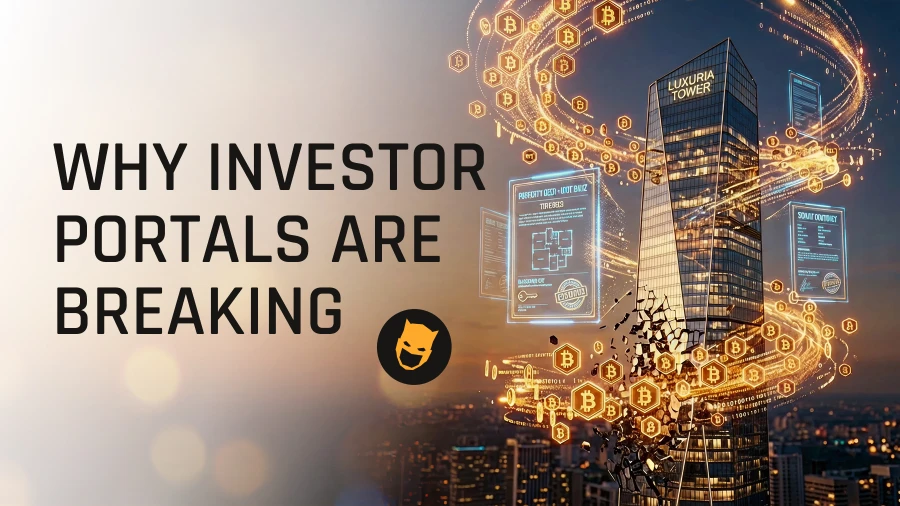
The real estate investment world is facing a quiet operational crisis. As investor expectations shift toward instant access, self-service dashboards, and real-time reporting, most private funds are still running on quarterly PDF statements, manual onboarding, and email-based subscription flows.
The gap between what investors expect and what fund managers can deliver is widening – and the tools many firms have tried to plug it haven't worked.
As a result, more firms are exploring the development of a real estate tokenization platform that can support both investor experience and compliance requirements. This guide covers how these platforms work in practice: the underlying architecture, the components that matter, what a real build actually costs, and where implementation typically goes wrong.
What is real estate tokenization – and how does it work?
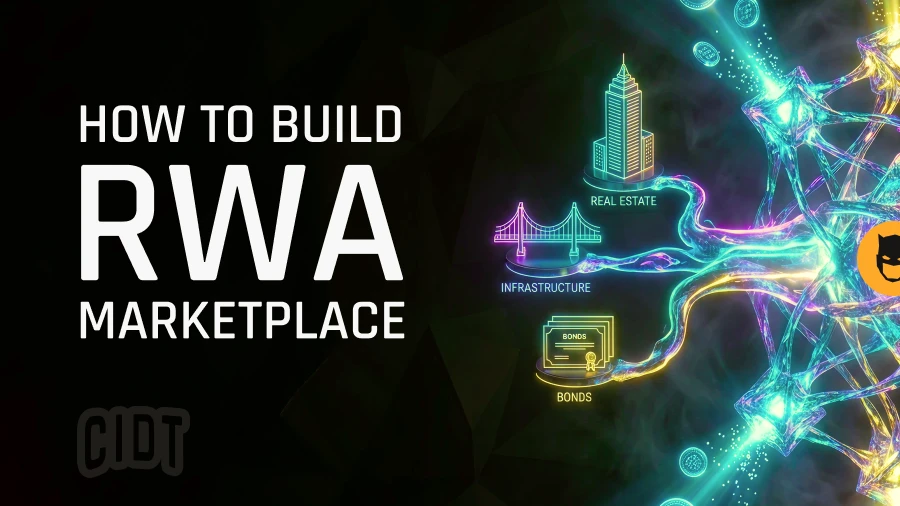
Real estate tokenization is the process of representing ownership rights in a property – or a portfolio of properties – as digital tokens recorded on a blockchain. Each token corresponds to a defined share of the underlying asset, allowing multiple investors to participate without purchasing the property outright.
In practice, the mechanics look like this: a legal entity (typically a Special Purpose Vehicle, or SPV) holds title to the property. Investors purchase tokens that represent fractional ownership in that SPV. The token itself is a smart contract on a blockchain – most commonly an ERC-20 token on Ethereum or a compatible EVM chain – that records who owns what, enforces transfer restrictions, and automates distributions.
A $10 million commercial property can be divided into 10,000,000 tokens at $1 per unit. An investor purchasing $50,000 worth of tokens holds a 0.5% economic interest in the SPV that owns the asset. Distributions flow automatically through the smart contract based on token holdings.
This structure does not replace the legal concept of property ownership – it sits alongside it. The SPV owns the deed; token holders own shares in the SPV. That distinction matters enormously for compliance, which we cover in detail below.
The tokenization process, step by step
For fund operators evaluating platform development, understanding the end-to-end flow is essential:
- Asset selection and legal structuring – the property is identified, a dedicated SPV is incorporated, and legal due diligence is completed.
- Tokenomics design – total supply, nominal unit value, transfer restrictions, and distribution mechanics are defined with legal and financial advisors.
- Smart contract development – an ERC-20 (or compliance-enabled variant such as ERC-3643) token is written, audited, and deployed to the chosen network.
- Platform deployment – the investor portal, admin panel, KYC/AML integrations, and payment infrastructure are built and tested.
- Investor onboarding – investors complete KYC, connect a wallet or use a custodial option, and fund their accounts.
- Token issuance – tokens are minted and distributed to verified investors; the blockchain records initial ownership.
- Ongoing operations – distributions are executed, investors manage holdings through the dashboard, and the admin panel handles reporting and compliance.
The problem that drives most tokenization projects
For a growing real estate fund, the compliance and reporting burden grows faster than the investor base. Every new investor means more KYC documentation, more subscription agreements, more quarterly statements assembled by hand.
Investors who manage portfolios through platforms like Fidelity expect real-time visibility as a baseline. Waiting 90 days for a PDF statement reads as a signal about how the fund is run – regardless of what the returns look like. That expectation gap erodes confidence quietly, over time.
Some firms have turned to off-the-shelf property management platforms to close it. In our experience working with real estate fund operators, the investor-facing modules in these systems consistently underdeliver. They are designed around property tracking workflows, and investor relations is a secondary concern at best. One client spent months on implementation before abandoning the platform entirely – the investor portal did not meet the standard their clients had come to expect from other investments.
The common thread in failed implementations: the platform was selected for its property management capabilities, not its investor-facing functionality. These are fundamentally different products.
What a real estate tokenization platform actually includes
A real estate tokenization platform, as we build it, is a full investor portal: it covers onboarding, transactions, reporting, and compliance within a single system. Token issuance is one component of that system, not the end product.
1. Onboarding and KYC/AML compliance
Automated KYC/AML verification with accreditation checks needs to be seamless for non-technical investors – many of whom are high-net-worth individuals with no prior exposure to blockchain products. The onboarding flow should feel comparable to opening a brokerage account: straightforward, professional, and requiring no technical knowledge from the investor.
In one recent project, KYC integration and the full onboarding process accounted for roughly 20% of the total development scope – significant, but manageable when the flow is designed around the investor's context rather than a generic compliance checklist.
2. Authentication & wallet access
Not all investors want a crypto wallet. A well-designed tokenization platform supports traditional email/password login alongside optional Web3 wallet connection (MetaMask, WalletConnect). For non-crypto users, a custodial wallet service – such as Fireblocks, Web3Auth, or Portal MCP – handles the blockchain layer invisibly.
This is not a detail. For funds with institutional or high-net-worth individual investors, the requirement that users understand private key management is a deal-breaker. The platform has to abstract that complexity completely.
3. Payments & on-ramps
For funds dealing in $150K–$250K+ ticket sizes, card payments alone won't work. The architecture needs bank transfer and wire integrations alongside card processing – and the experience should feel just as smooth regardless of which method an investor uses.
Bank wire integration is one of the most technically complex components of a tokenization platform. In a recent project, it accounted for roughly 14% of the total development scope – the single largest individual item. Wire reconciliation, currency handling, and settlement timing require significant custom logic that no off-the-shelf payment library fully handles.
4. Investor dashboard
This is where the trust is built. Investors need to see their holdings, distributions, reinvestments, and portfolio value in real time — not at the end of the quarter. They need to submit withdrawal requests, track status, and access historical statements without calling anyone.
The dashboard covers: portfolio summary, equity holdings breakdown, activity and deal history, P&L reporting, and distribution records. Each of these seems straightforward in isolation; the complexity is in keeping them consistent and real-time as the underlying asset valuations and distribution events change.
5. Admin panel
The other side of the portal matters just as much. Fund managers need tools to update property valuations, manage distribution schedules, approve withdrawal requests, push investor communications, and manage user access – all without touching code.
A strong admin layer is often what separates a functional system from a usable one. In a recent project, the admin portal – covering user management, reporting, portfolio management, and activity deal management – accounted for roughly 38% of the total development scope, the largest single component in the build.
6. Smart contracts and tokenomics
One of the trickier aspects of real estate tokenization is getting the token structure right. In a recent project, we used a standard ERC-20 token with transfer restrictions limiting transactions to verified holders only – implemented as an additional smart contract function with on-chain whitelist logic.
The nominal unit value matters more than most clients expect. A $1/unit structure can create regulatory complications around stablecoin classification in some jurisdictions. The nominal unit value, total supply, and distribution mechanics need to be designed with legal review before a single line of smart contract code is written.
Technical architecture and stack
The platform described above is a full-stack application with a blockchain layer. The architecture has to handle several distinct concerns simultaneously: a user-facing investor application, a fund manager admin application, a blockchain interaction layer, and a compliance data layer.
The stack we use
For a typical real estate tokenization platform, our stack includes:
- Frontend: ReactJS with TypeScript – component-based UI, type safety, maintainable codebase
- Backend: Node.js – fast I/O, strong ecosystem for financial integrations
- Database: PostgreSQL – relational structure for complex financial data, investor records, compliance logs
- Infrastructure: AWS – scalable, enterprise-grade, audit-ready
- Blockchain: Solidity smart contracts on EVM-compatible network, ERC-20 token standard
How the layers interact
The application layer never writes directly to the blockchain. A dedicated blockchain API service handles all on-chain interactions – minting tokens, distributing to wallets, burning tokens on redemption, and querying balances. This separation matters for two reasons: it makes the system testable without blockchain dependencies, and it allows the smart contract layer to be audited and upgraded independently of the application.
The custodial wallet system sits between the user application and the blockchain API service. When a non-crypto investor completes onboarding, a wallet is created on their behalf, backed up with KMS integration, and used for all transactions without the investor ever managing keys directly.
CI/CD and infrastructure
Production deployments use GitHub Actions for CI/CD and Terraform manifests for infrastructure-as-code. In a compliance environment, this creates an auditable, repeatable deployment history that regulators can review at any point.
Compliance requirements
Any real estate tokenization platform handling investor capital in regulated markets needs to be built compliance-first. That means immutable audit logs, role-based access controls, and a data architecture that can survive regulatory scrutiny.
What compliance-first architecture actually means
Every action in the system – every login, every transaction, every distribution event, every admin action – is logged with a timestamp and user ID in an append-only table. Access to investor data is governed by roles defined in the application layer, with no direct database access for operational users. KYC records, accreditation status, and investment agreements are stored in a structure that can be exported and presented to a regulator on short notice.
For funds operating under securities law – particularly in jurisdictions like Canada, the United States, or the EU under MiCA – compliance architecture is a day-one decision. Retrofitting compliance controls into an existing system is typically more expensive than building them in from the start.
Token transfer restrictions
In most jurisdictions, tokens representing securities cannot be freely traded on the open market without regulatory approval. The smart contract implements this at the blockchain level: transfer functions are limited to whitelisted addresses only. When an investor completes KYC and accreditation verification, their wallet address is added to the whitelist. The smart contract enforces this restriction directly – rejection happens at the protocol level, where application-layer controls do not reach.
Investor accreditation
Depending on jurisdiction, the platform must verify that investors meet accreditation requirements before they can purchase tokens. This verification needs to be documented, time-stamped, and re-verified periodically. The platform stores accreditation records against the investor profile and can be configured to block transactions when accreditation status expires.
Real estate tokenization platform: challenges
Building a functional tokenization platform is achievable. Building one that remains functional, compliant, and trusted by investors over time is harder. These are the challenges most teams underestimate:
Regulatory complexity across jurisdictions
A fund operating in Canada faces different securities law than one operating in the United States or the EU. A platform designed for one jurisdiction may require significant re-architecture to operate in another. The ERC-3643 token standard was developed specifically to address cross-jurisdictional compliance requirements for security tokens – but adopting it adds development complexity and a more demanding audit requirement.
The regulatory environment continues to evolve. MiCA in the EU came fully into effect in 2026, creating new obligations for issuers of asset-referenced tokens. Fund operators building platforms today need to design for regulatory adaptability, with compliance logic that can be updated as frameworks change.
Investor UX for non-crypto audiences
The population of investors in private real estate funds is not the same as the population of DeFi users. Many are professionals in their 40s and 50s who have never held a crypto asset and have no intention of learning what a gas fee is. A platform that requires any blockchain literacy from investors will fail to achieve adoption – regardless of how technically sound the underlying architecture is.
Solving this is an architectural decision, not a UX afterthought: custodial wallets by default, fiat on-ramps without stablecoin exposure, and a user interface that never surfaces blockchain terminology to the end investor.
Secondary market liquidity
Token holders may expect to be able to sell their holdings before the fund's exit event. Creating a secondary market for real estate security tokens requires either a licensed trading platform or a bilateral transfer mechanism with compliance checks. Neither is simple. Most tokenization platforms in operation today do not provide meaningful secondary liquidity – the tokens are more like digitized LP interests than tradable securities.
Setting investor expectations correctly at the time of onboarding is as much a platform design problem as a legal one. The platform should make the liquidity terms visible and acknowledged before investment.
Smart contract auditability
Unlike application code, smart contract vulnerabilities cannot be silently patched after deployment. Every fix requires a new contract, a migration process, and re-verification by investors and regulators. This makes the pre-deployment process – formal code review, security audit, testnet validation – a critical gate that defines the risk profile of the entire platform. Compressing or skipping it transfers that risk directly to investors.
Off-chain / on-chain data consistency
The blockchain records token ownership. The application database records investor identities, investment agreements, KYC status, and financial transactions. These two systems must remain consistent. If a token transfer is recorded on-chain but the application database fails to update, the investor's displayed portfolio will be wrong. Handling this consistency – especially across network failures, reorgs, and edge cases – is one of the most technically demanding aspects of tokenization platform development.
What it costs to build a real estate tokenization platform
Development scope and timeline vary based on the fund's structure, compliance requirements, and the integrations involved. A platform covering the full component set described in this article – investor portal, smart contracts, custodial wallets, KYC/AML, payment infrastructure, and admin panel – typically takes 4–5 months from kickoff to production-ready delivery.
The most reliable way to scope a project is through a discovery conversation: we map your fund structure, investor base, and regulatory environment, and build the estimate from there.
Get in touch →
Smart contract audit and remediation
Smart contract audit is a separate budget item from platform development. At CIDT, we analyze contracts for logic flaws, access control gaps, and security vulnerabilities, fix the issues, and validate the changes before production deployment.
Phased delivery
We use a phased delivery approach. The first phase delivers a working investor portal: KYC/AML onboarding, portfolio visibility, and basic reporting. Subsequent phases layer in self-service transactions, full tokenization rails, and advanced admin tooling. This gives the fund operator something to show investors early while the full platform is built out.
Build vs. buy: why off-the-shelf platforms fall short
The SaaS tokenization market has grown significantly. Platforms like Brickken, Tokeny, and others offer white-label tokenization infrastructure. For some use cases – particularly funds with standardized structures and no special compliance requirements – these are worth evaluating.
For fund operators with specific compliance environments, custom investor onboarding flows, or integration requirements with existing fund administration systems, the limitations of white-label platforms become significant quickly. The investor portal is the most common failure point: these platforms are built for general-purpose asset tokenization, not for the specific UX and compliance requirements of private real estate funds.
The funds that succeed in digitizing their investor operations are the ones that invest in purpose-built tokenization platform development aligned to their specific fund structure, investor base, and compliance environment.








.svg)


