We've had the same conversation more than once. A team has a tokenized asset, a launch date, and a marketplace interface — and then discovers, usually under time pressure, that the compliance layer can't survive a regulator's question, the custody setup doesn't work for institutional buyers, and the onboarding workflow depends on someone doing things manually in a spreadsheet.
This article covers the architectural decisions that determine whether a platform holds up in production.
Investor segmentation in RWA marketplace development
Investor segmentation and the compliance model are the first architectural decisions in RWA marketplace development, and they determine everything downstream, including the token standard. Real estate assets are almost always securities, which means programmable compliance logic has to be part of the token design from the start. The choice between ERC-3643, ERC-7518, or a custom compliance-hook approach will determine how the platform handles investor eligibility across jurisdictions and how much engineering effort that adds as the platform scales. This decision belongs in the architecture conversation before anything gets built.
Most platforms serve at least three meaningfully different buyer types, each with different security requirements, different UX expectations, and different compliance implications.
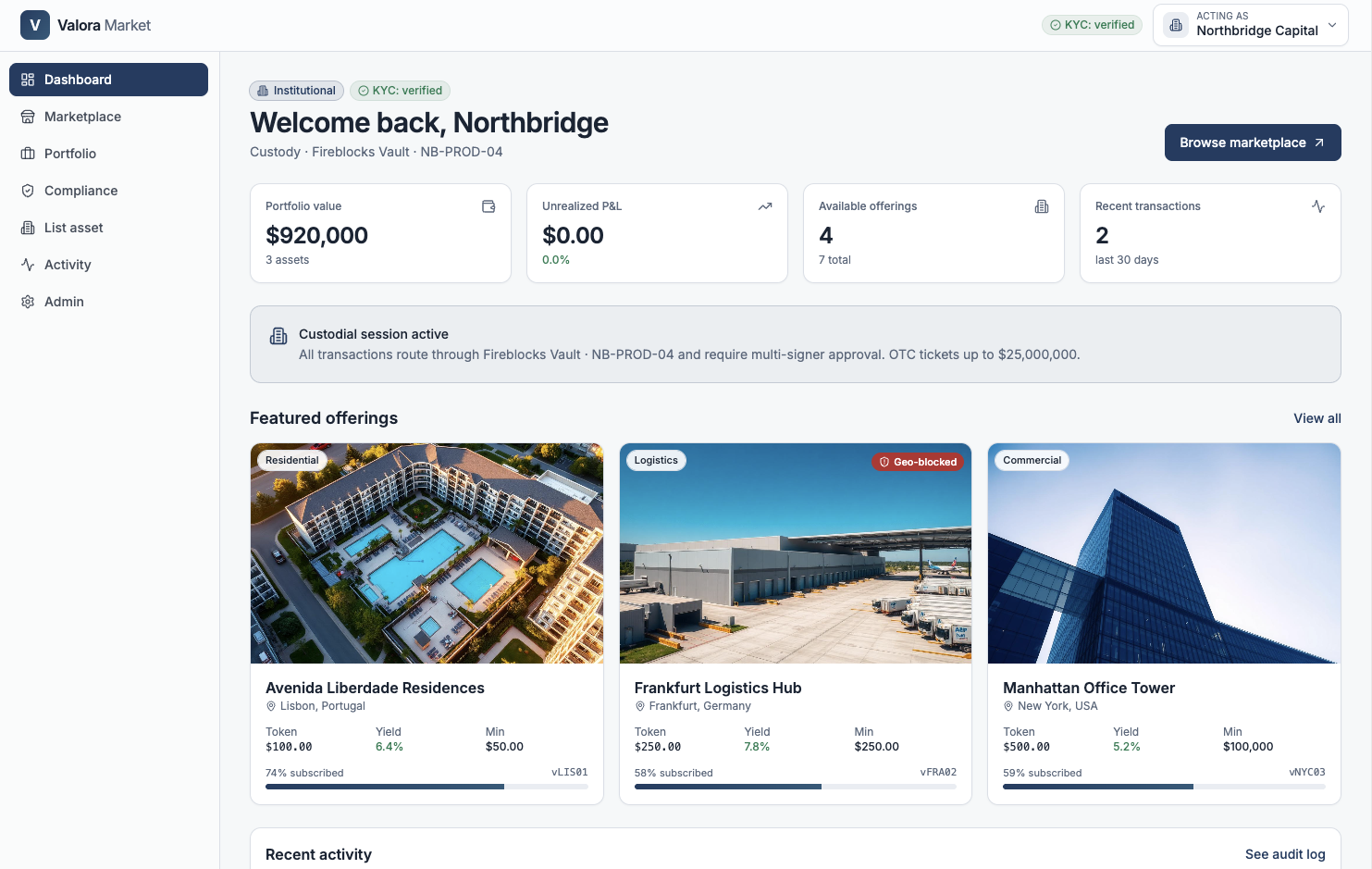
Institutional investors — family offices, funds, OTC buyers — operate at ticket sizes where the purchase flow, custody model, and reporting infrastructure have to be built specifically for them. In practice, this means Fireblocks or equivalent for custody, multisig controls on every transaction, and a buying flow designed for large, deliberate purchases at the scale institutional buyers operate. Bulk purchases go through OTC rails rather than a public order book. The system has to survive a compliance audit from an LP or regulator, which means every transaction needs a full audit trail.
Crypto-native investors — DeFi-familiar, self-custodying — have a natural affinity for on-chain transparency and self-custody, and expect non-custodial wallet connectivity across EVM-compatible chains and access to secondary liquidity. They expect to connect a Coinbase wallet or MetaMask and see their holdings on-chain. If the platform doesn't support that, this segment won't use it. They also expect liquidity mechanisms: some form of trading or exit path, beyond a static listing.
Consumer investors — lower minimums, card payments or bank transfers, no crypto knowledge assumed — need a UX that feels like a brokerage account. At minimum ticket sizes of $100–$200, the onboarding flow, payment rail, and portfolio view have to work for someone who has never held a crypto asset and has no intention of learning what a gas fee is. AI-assisted navigation — letting an investor describe what they're looking for in plain language and get matched to appropriate offerings — is increasingly part of what this segment expects. The blockchain layer has to be completely invisible.
The compliance requirements for each segment are specific enough that adding a second segment as an afterthought typically means reworking core infrastructure. A custody model built for institutional OTC purchases requires significant re-engineering to handle a $100 card transaction. A DeFi-native trading interface carries reporting gaps that institutional LPs will surface in due diligence.
The right architecture serves all three from a single underlying compliance and token layer, with the interface, custody model, and payment rails adapting per segment.
If your platform serves a single fund rather than a public marketplace, the architecture is somewhat more contained. We cover that separately – stack decisions, cost breakdown, and compliance design for a single-fund tokenization platform: real estate tokenization platform development.
RWA platform compliance: the technical layer most teams get wrong
"Regulator-friendly" is a positioning claim, and the data architecture underneath is what makes it defensible.
A compliance-first RWA platform logs every investor action — KYC verification, wallet connection, purchase, transfer, exit — immutably and queryably by asset, investor, and time period. Immutable, queryable logging is the cornerstone of everything that follows: when a regulator asks, the answer needs to already exist in the system.
In production, geofencing and sanctions screening operate at the session level as a first gate, but session-level checks only control what the interface shows. On-chain transfer hooks are what enforce investor eligibility at the moment of transfer: a non-verified investor cannot receive tokens because the smart contract rejects the transaction directly, regardless of what the interface shows.
Modern implementations handle this through a few different mechanisms: soulbound or identity-linked claims tied to the investor's wallet, dynamic whitelisting updated via trusted oracles, or compliance-aware token standards like ERC-3643 where jurisdictional rules are embedded in the token itself. The right choice depends on the target jurisdictions and how the platform plans to handle secondary trading.
This layer is unglamorous to build and consequential to skip — and in retrospect, enforcing eligibility at the contract level is always the decision teams wish they'd made before launch, not after. A platform that hasn't done this will stall the first time a regulator or institutional LP asks to see the audit trail.
A well-architected RWA marketplace also separates platform liability from issuer liability. The platform is responsible for the onboarding process — KYC, document checks, compliance guidance — while the legal wrapper around each asset belongs to the issuer. This distinction has to be reflected in the architecture: the platform provides the rails, and the issuer provides the regulatory opinion.
AI as a compliance instrument in RWA platforms
There's a specific use of AI in RWA platforms that regulators respond to positively and that most teams underestimate. When an AI agent can explain an investment product to a retail investor — in their language, at their level of financial sophistication — it addresses one of the core regulatory concerns: that different investor types are receiving materially different understandings of the same product.
A platform that ensures consistent, accurate, appropriately calibrated disclosure across investor types addresses two points regulators consistently raise: disclosure consistency across investor sophistication levels, and language accessibility. Multilingual support extends this further: the same standard of disclosure, delivered in the investor's language, without a human intermediary in the loop.
The function here is investor-level calibration. The system understands who it's talking to and adjusts depth, terminology, and framing accordingly, while keeping the substance of the disclosure consistent. A compliance-grade AI integration operates at the level regulators care about — disclosure accuracy and consistency across investor types — which is what makes it relevant to the platform's regulatory defensibility, well beyond conversion metrics.
What asset onboarding actually involves
The token itself can be minted in hours. The legal, structural, and compliance work that has to happen before minting typically takes weeks.
Before a property can be listed on a compliant RWA marketplace, it needs to clear a structured onboarding chain: SPV formation, legal opinion, title verification, independent valuation, KYC/KYB of the issuer, and a regulatory wrapper appropriate to the target jurisdiction. Each stage has different stakeholders, different dependencies, and a different definition of "done." The entire workflow needs to produce an audit trail that can be presented to regulators, investors, or legal counsel on demand.
This is particularly acute in real estate because jurisdictional differences in property law are more prevalent than most platform builders expect. Valid title transfer in the UK follows different rules than in the UAE or the US, and a platform serving issuers in more than one jurisdiction needs an onboarding workflow that can accommodate those differences without requiring a custom build per market.
Most teams building their first RWA platform run into this at scale: it becomes evident around the tenth asset that the submission process that worked manually starts breaking down. The forms, approval logic, and document verification that feel manageable at low volume become the operational bottleneck as the asset count grows. Building onboarding infrastructure that scales — configurable approval workflows, AI-assisted document verification, automated fraud and ownership checks — is one of the highest-leverage investments a platform can make early, precisely because the cost of retrofitting it later is measured in delayed listings and lost issuers.
For platforms with ambitions toward decentralized governance, the workflow also needs to be configurable from the start: who approves what, what escalation paths exist, how disputes are recorded.
Decentralized validation as an onboarding integrity mechanism
One architectural pattern worth considering for platforms that want to scale asset onboarding without centralizing trust: validator staking. Under this model, approved underwriters purchase validator status and put capital at risk when approving an asset. If a validated asset is later found to have integrity issues, the validator's staked position is exposed.
This creates an economic incentive structure with auditability and accountability built into the approval process itself. It also gives investors and regulators a concrete signal that asset quality standards are enforced at the economic level, through staked capital, rather than through internal policy alone. The governance design is complex and typically a later-phase item, but the data model and token architecture need to accommodate it from the start if it's on the roadmap.
Onboarding infrastructure is also where execution gaps tend to surface first. A process that runs smoothly for a handful of assets — managed manually — will become a bottleneck as volume grows, and retrofitting it under operational pressure is significantly more expensive than building it correctly early.
For issuers unfamiliar with securities law in a target jurisdiction, the onboarding workflow itself can serve as a compliance guide — surfacing the required registrations, recommending approved legal providers, and tracking completion. The platform's role is to provide the process that gets the issuer to a legal opinion, with the opinion itself remaining the issuer's responsibility.
Payment rails and the ceiling they create
An RWA marketplace built around a single payment method will hit a hard ceiling on its investor base, and the constraint becomes apparent earlier than most teams plan for.
Institutional OTC purchases, bank wire transfers, card payments, and on-chain wallet transactions are four different integration problems, with different settlement timelines, different failure modes, and different compliance implications. A $200,000 wire and a $500 card purchase need to arrive in the same portfolio system, trigger the same downstream compliance logging, and produce the same investor record. Without that reconciliation built into the architecture, the operational overhead of handling it manually becomes a growth bottleneck before the platform reaches any meaningful scale.
Payment rails are the practical enablers of investor participation — coverage determines which segments can actually transact, and therefore how large the addressable market is in practice.
Secondary market: design it early, launch it later
Every RWA platform founder eventually faces the gap between the "liquid asset" promise and the operational reality of compliant secondary trading.
The practical answer is to build primary market rails correctly and design secondary market readiness into the data model from day one, treating launch and secondary trading as two separate phases. A lockup period on an initial offering is a realistic design choice. The question is whether, when that lockup expires, the platform still has the data structures in place to support compliant secondary trading: full ownership history for every token, transfer eligibility logic, exit condition tracking, and a portfolio management layer ready to route secondary transactions.
Getting the data model right comes first. The harder constraint is regulatory: full compliant secondary trading requires either a regulated ATS (Alternative Trading System), a broker-dealer wrapper, or a marketplace operating under a specific license in each target jurisdiction.
Platforms that defer secondary market design often find the primary market architecture needs significant rework to support it. The regulatory groundwork — licensing, jurisdictional analysis, legal structuring — typically runs on a longer timeline than the technical build, which means it needs to be initiated well before the technical work begins.
Tokenizing yield in RWA platforms
The most compelling RWA structures include yield tokenization alongside ownership. When revenue events are recorded on-chain as they occur — rent collected, a room booked, a transaction processed — minority token holders get the same data visibility as the operator, with every income event verifiable at the contract level.
That level of transparency changes the investor proposition and the platform's market position. A platform that can credibly demonstrate real-time, on-chain yield attribution is offering a yield instrument with blockchain-native transparency, which is structurally distinct from a platform that tokenizes a legal claim to an offline asset and reports performance periodically.
Building toward this requires oracle infrastructure that connects off-chain business events to on-chain records in real time. For most platforms, this is aspirational at launch — but it shapes how the data model and smart contract architecture need to be designed from the start, which means the decision belongs in the phase-one architecture conversation even if the implementation comes later.
Phased delivery on a unified architecture
RWA platform development tends to fail in one of two ways: teams scope everything upfront and spend six months delivering nothing, or they ship quickly and find the architecture can't support what comes next. The right model is phased delivery on a foundation designed for the complete product from the start.
Phase one ships the minimum functional sales rail: investor onboarding, KYC/KYB, wallet connectivity, a compliant purchase flow, admin controls, and basic reporting. Phase two adds structured asset onboarding, expanded payment rails, and full reporting infrastructure. Later phases add DeFi components, AI-assisted investor interactions, secondary market mechanics, and governance tooling.
Bottom line is, the compliance data model, the token infrastructure, the custody integrations, and the audit trail structure are all designed for the complete product in phase one, with functionality shipping incrementally against that foundation.
The sweet spot is an architecture designed to support the full product from day one, with delivery staged across phases — and that's what separates a launch rail from an MVP, which is scoped to solve the immediate problem and extended later, often at the cost of rework.
At CIDT, we build production-ready Web3 infrastructure for teams that need to get the architecture right the first time. If you're designing an RWA marketplace or tokenization platform, let's talk.



















.svg)


